
But what will work mean in a knowledge society, or indeed in some form of an 'experience society'? What will happen when merely maximizing efficiency and productivity becomes the chief domain of machines, rather than humans?
Most of us used to work because we needed to earn a living. Those that didn't work in the traditional sense such as some artists, spiritual leaders, rich heirs and the independently wealthy, dropouts or those that were somehow unfit to work, were looked upon as a burden to society since their contributions were not measurable by conventional metrics.
Does an artist or an inventor or an author 'work' in the same way as an engineer or a factory labourer? Hardly. Yet, these 'right-brain'- dominated occupations may be the destination that many of us may be headed in, soon.
The distinction of 'having work' or not will change very soon as 'work' in its traditional sense will be increasingly hard to come by in the near future; technology is rapidly automating every single job that has any machine-like component.
This is an inevitable trend that will change our society at the core. In less than seven years, it will not take some 337 low-skilled workers to assemble an iPad in China — it will take 20 smart robots and 20 workers running them.
Imagine a time in the not too distant future when Artificial Intelligence (AI) powered services file our taxes for us or plot our physical exercise according to our actual needs and body readiness at that very moment. In the past, many data-crunching tasks such as accounting were handled by real people using computers to find answers that made sense to humans.
Most of this is sure to vanish as machines become truly intelligent, and as interfaces go from type to speak to gesture to blink to 'think'. The term 'work' itself may soon become quite useless and I propose a new term: workupation, better suited to describe our future because whatever we will be occupied with is very likely to become our new work, monetised in a myriad of new ways, many of which are inconceivable today.
Just take a look at how Flattr is proposing to pay people for their journalistic contributions, and how social reputation is already metered on platforms such as Klout or Peerindex. We are rapidly becoming a truly 'networked society' and 'work' is one of those core disruption zones that is impacted by the exponential advancements in 'big data' technologies, machine intelligence , robotics and overall automation. Crowdsourcing, tele-working and the globally overall dissolving barriers between industries are additional trends that impact the future of work.
We must also consider that the global trend towards mobilization, the rampant consumerizationof IT and the total empowerment of consumers that goes with it. Recent studies have confirmed that many of us now work 10-20 % more than before we had smartphones and social business-networks . It is already hard to say if what we are doing at any given moment is 'work' or not.
It is simply 'what we do' and often what we feel passionate about - and this trend will only get stronger in the future as we are leaving the menial data-driven and somewhat mechanical tasks to smart machines and move on to focus on our human-only capabilities. This, to me, defines the shift from work to workupation — we will be occupied with projects and issues that really matter to us rather than those that require machine-like skills or (worse) machine-thinking; and of course, machines will beat us hands-down at being cheaper, faster and more reliable on 99% of those tasks, as well.
So what will happen when smart machines and AI take over 30-50 % of our jobs? How will we cope with what we now call 'unemployment' of over 50%? This will be nothing less than a total redefinition of work , jobs and employment, itself, and maybe those of us that have been lucky enough to consider their work to be what they would do even if they did not have to do it - or would not get paid for it, those that have found their true calling regardless of remuneration, can show us the way towards this future.
A future that will measure the value of our work not by 'units' that we have turned out, not by our contribution to increasing the GDP/GNP by merely increasing consumption or profits. A future that will measure our contributions wider, deeper and ultimately in a more human way.


 Apple
has acquired SnappyLabs, a one-man app maker behind the
now-discontinued SnappyCam app. The app was removed from the App Store
-- along with its website and social media presence -- within the past
few days. According to TechCrunch, which first reported the
acquisition: Sources have since affirmed that the company was acquired
by Apple, and that there was also acquisition interest “from most of the
usual players”, meaning other tech giants. I don’t have details on the
terms of the deal, and I’m awaiting a response from Apple, which has not
confirmed the acquisition.Back in July, SnappyCam was upgraded with new
technology, detailed in a now-deleted blog post (still viewable via
Archive.org), that explains how developer John Papandriopoulos was able
to redesign how JPG images are compressed, allowing the iPhone to shoot
full-quality burst mode photographs at significant higher frames per
second than other competing technologies, including the new burst mode
built into iOS 7.
Apple
has acquired SnappyLabs, a one-man app maker behind the
now-discontinued SnappyCam app. The app was removed from the App Store
-- along with its website and social media presence -- within the past
few days. According to TechCrunch, which first reported the
acquisition: Sources have since affirmed that the company was acquired
by Apple, and that there was also acquisition interest “from most of the
usual players”, meaning other tech giants. I don’t have details on the
terms of the deal, and I’m awaiting a response from Apple, which has not
confirmed the acquisition.Back in July, SnappyCam was upgraded with new
technology, detailed in a now-deleted blog post (still viewable via
Archive.org), that explains how developer John Papandriopoulos was able
to redesign how JPG images are compressed, allowing the iPhone to shoot
full-quality burst mode photographs at significant higher frames per
second than other competing technologies, including the new burst mode
built into iOS 7. 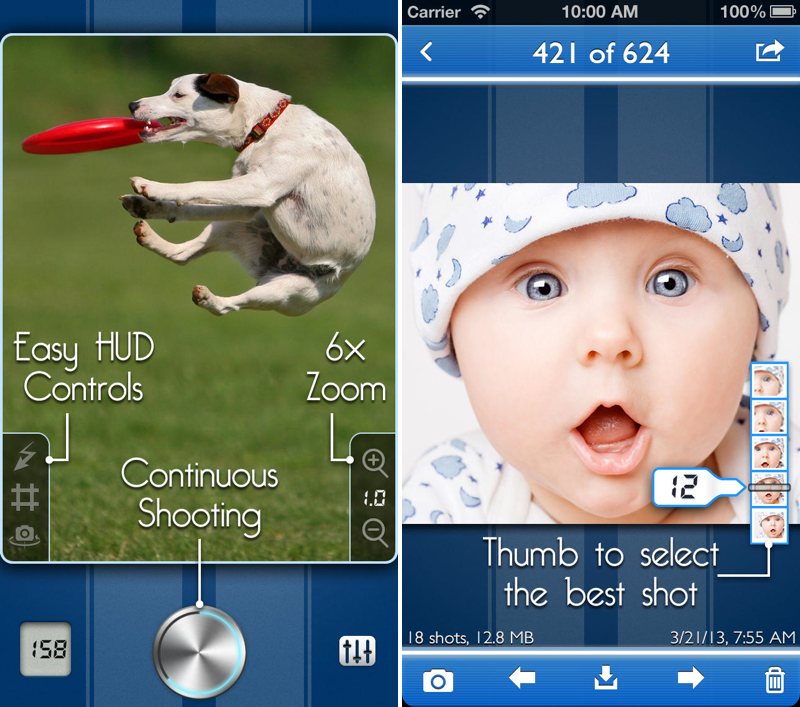 With the acquisition, it seems likely that Apple will integrate the
SnappyCam technology into its native iOS and OS X camera programs and
APIs. Apple added burst mode photo shooting to iOS 7, allowing iPhone 5s
owners to shoot 10 photos per second at full resolution, in order to
get the best shot in action scenes or with fast-moving children.
SnappyCam is no longer available for download from the App Store.
Pricing and other details were not revealed, and Apple has not yet
confirmed the acquisition.
With the acquisition, it seems likely that Apple will integrate the
SnappyCam technology into its native iOS and OS X camera programs and
APIs. Apple added burst mode photo shooting to iOS 7, allowing iPhone 5s
owners to shoot 10 photos per second at full resolution, in order to
get the best shot in action scenes or with fast-moving children.
SnappyCam is no longer available for download from the App Store.
Pricing and other details were not revealed, and Apple has not yet
confirmed the acquisition.


